

create the same cinematic style:

-PROMPT-
California Does Offer Home Loan Programs — Here’s What You Need to Know

Does California offer a home loan program? Yes — and not just one. The state offers several programs to help residents buy homes, reduce upfront costs, and access affordable financing.
Quick answer:
- CalHFA (California Housing Finance Agency) is the main state agency offering home loans in California
- Programs include FHA, VA, USDA, and conventional first mortgages — all on 30-year fixed rates
- Down payment assistance is available through programs like MyHome, Dream For All, and others
- First-time and first-generation buyers have access to specialized programs with extra benefits
- Loans are not issued directly by CalHFA — you apply through CalHFA-approved private lenders
For many Californians, the biggest barrier to homeownership isn’t qualifying for a mortgage — it’s coming up with the down payment. That’s exactly the gap these programs are designed to fill.
California’s housing market is one of the most expensive in the country. But since 1975, CalHFA has been quietly helping low-to-moderate income buyers get into homes by pairing state-backed first mortgages with down payment assistance. The result is a layered system that can make buying a home significantly more affordable than going it alone.
This guide breaks down every major program, who qualifies, and how to get started.
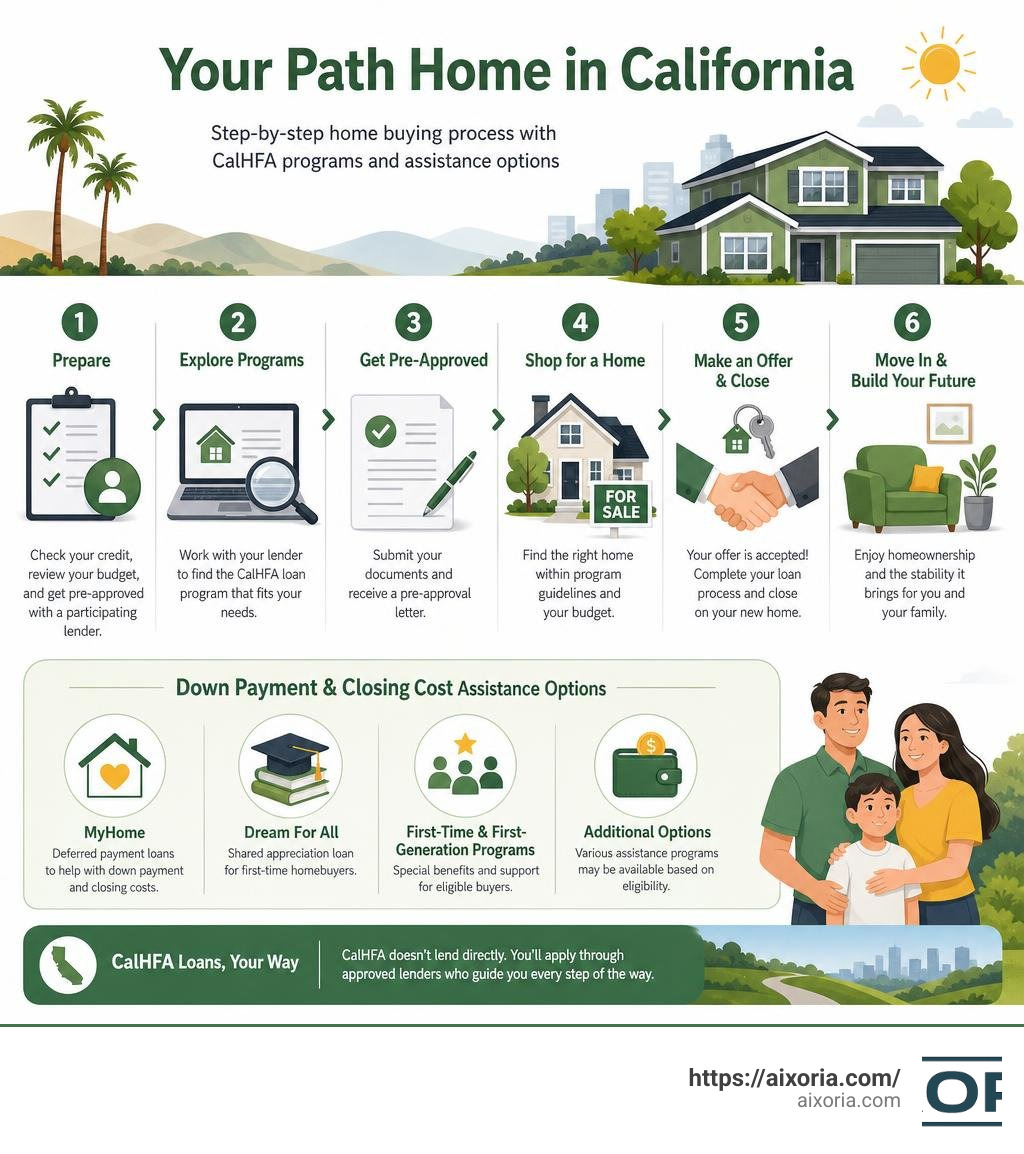
Does California Offer a Home Loan Program?
If you are asking yourself, “Does California offer a home loan program?” the short answer is an enthusiastic yes. Through the California Housing Finance Agency (CalHFA), the state provides a robust suite of single-family lending options designed specifically for low-to-moderate-income households.
CalHFA operates as California’s affordable housing bank. However, a common point of confusion is how these loans are actually distributed. CalHFA is not a direct lender. It does not hand checkbooks to homebuyers or approve mortgage applications in-house. Instead, CalHFA partners with a network of approved private lenders, brokers, and loan officers who handle the day-to-day origination, underwriting, and processing of the loans.
All first mortgages offered through CalHFA are structured as 30-year fixed-rate loans. This ensures predictability and stability for buyers, protecting them from the volatility of adjustable-rate mortgages. These state-backed loans are designed to be paired seamlessly with junior loans (or “silent seconds”) that cover down payments and closing costs.
To take advantage of these programs, buyers must follow a structured path. This includes verifying their eligibility, finding an approved lender, completing mandatory homebuyer education, and finding a property that meets the state’s guidelines. For a comprehensive breakdown of this journey, you can review the official Steps to Buying a Home | CA Housing Finance Agency.
CalHFA First Mortgage and Down Payment Assistance Programs

When navigating California’s home loan landscape, we can divide the state’s offerings into two core categories: first mortgages and down payment assistance programs. To achieve the lowest possible out-of-pocket cost, we often recommend that buyers layer these programs together.
CalHFA’s first mortgages are divided into government-backed options and conventional options:
- Government Loans: These include FHA (Federal Housing Administration), VA (Veterans Affairs), and USDA (U.S. Department of Agriculture) loans. They are highly accessible, often requiring lower credit scores and featuring flexible underwriting guidelines.
- Conventional Loans: These are standard mortgages insured through private mortgage insurance (PMI). CalHFA offers programs like the CalHFA Conventional, which can be paired with reduced mortgage insurance premiums for lower-income borrowers.
What makes CalHFA unique is how these first mortgages interact with down payment assistance. These assistance programs are structured as “silent seconds.” This means they are subordinate junior loans that require no monthly payments from the borrower. Instead, payment is deferred until the home is sold, refinanced, or the first mortgage is fully paid off. This structure keeps your monthly housing costs highly affordable.
To help you visualize how these first mortgage options compare, we have put together a comparison table of the primary CalHFA conventional and government pathways:
| Feature / Program | CalHFA Conventional | CalHFA Government (FHA/VA/USDA) |
|---|---|---|
| Loan Type | Conventional (Fannie Mae / Freddie Mac) | FHA, VA, or USDA-backed first mortgage |
| Term | 30-Year Fixed | 30-Year Fixed |
| Max LTV | 97% | Up to 100% (for VA and USDA) |
| Mortgage Insurance | Private Mortgage Insurance (PMI) | Government-specific (MIP, Guarantee fees) |
| Down Payment Help | Can pair with MyHome (up to 3%) or ZIP | Can pair with MyHome (up to 3.5%) or ZIP |
| Underwriting | DU Approve/Eligible (No manual underwriting) | Agency guidelines (FHA/VA/USDA) |
Lenders and real estate professionals can find detailed compliance guidelines in the CalHFA Lender Program Manual. If you are an industry partner looking to help clients access these tools, you can explore resources on the portal for Lenders Real Estate Agents & Nonprofits | California Housing Finance Agency.
How Does California Offer a Home Loan Program for First-Time Buyers?
For first-time buyers, the flagship program is the MyHome Assistance Program. To qualify as a first-time homebuyer under CalHFA guidelines, you must not have had an ownership interest in a primary residence (or resided in a home owned by a spouse) at any point during the three years prior to the loan signing.
The MyHome program provides a deferred-payment junior loan to cover your down payment and closing costs. The assistance limits depend on the type of first mortgage you choose:
- FHA First Mortgages: MyHome offers up to 3.5% of the purchase price or appraised value (whichever is lower).
- Conventional, VA, or USDA First Mortgages: MyHome offers up to 3% of the purchase price or appraised value.
To learn more about how to secure this funding, check out the official Downpayment Assistance Program | MyHome Assistance Program page.
Additionally, to ensure long-term homeownership success, CalHFA requires at least one occupying first-time borrower on the loan to complete a comprehensive homebuyer education course. This is typically done through eHome’s eight-hour online course (which carries a $100 fee), or via approved in-person counseling from HUD-approved agencies. To review the conventional mortgage requirements, visit First Time Home Loans | CalHFA Conventional Program.
Does California Offer a Home Loan Program for First-Generation Buyers?
For those who are the first in their families to buy a home, California created a highly innovative program: the California Dream For All Shared Appreciation Loan.
This program was designed to address systemic wealth gaps by providing first-generation homebuyers with up to 20% of the home’s purchase price or appraised value (not to exceed $150,000) to use for a down payment or closing costs.
Because this is a “shared appreciation” loan, it functions differently than a standard mortgage:
- No Monthly Payments: The junior loan requires no monthly payments.
- Repayment Structure: When you sell or refinance the home, you repay the original principal loan amount plus a percentage of the home’s actual value appreciation.
- Appreciation Share: For standard moderate-income borrowers, the shared appreciation ratio is 1:1 (if you received 20% assistance, you repay 20% of the home’s appreciation). For lower-income borrowers at or below 80% of the Area Median Income (AMI), the appreciation share is reduced to a favorable 0.75:1 ratio (meaning you only pay back 15% of the appreciation).
To qualify as a first-generation buyer, your parents must not currently own a home in the United States (or, if they are deceased, they must not have owned a home at the time of their death). Borrowers who have spent time in the California foster care system also automatically meet the first-generation definition.
Note: Due to massive demand, the Dream For All portal closed on March 16, 2026, after utilizing a randomized voucher drawing system to distribute funds fairly. Keep an eye out for future funding rounds or similar legislative expansions.
Eligibility, Income, and Property Requirements for CalHFA Loans
To keep these state-backed programs accessible to those who need them most, CalHFA enforces clear borrower, financial, and property guidelines.
1. Credit Score and Debt-to-Income (DTI) Limits
While private lenders may have their own overlays, CalHFA establishes baseline credit requirements:
- Credit Scores: The minimum credit score generally ranges between 660 and 680, depending on the specific first mortgage program and the borrower’s income tier.
- Debt-to-Income (DTI): The maximum DTI is typically capped at 45%, though it can stretch to 50% for borrowers with higher credit scores under certain conventional automated underwriting approvals.
- Underwriting: CalHFA conventional loans require Desktop Underwriter (DU) Approve/Eligible status. Manual underwriting is not permitted.
2. Income Limits
Because these programs are targeted toward low-to-moderate-income families, your total household income cannot exceed county-specific limits. These limits are updated annually and vary significantly. For instance, income limits in high-cost coastal areas like San Francisco or Los Angeles are scaled much higher than those in the Central Valley to reflect local economic realities.
3. Property Requirements
To qualify for a CalHFA loan, the property you are purchasing must meet the following criteria:
- It must be located within the state of California.
- It must be used as your primary residence. Borrowers must occupy the property within 60 days of closing.
- Eligible property types include single-family residences (SFRs), approved condominiums, planned unit developments (PUDs), and manufactured homes.
- Guest houses, granny units, and in-law quarters (ADUs) are permitted, provided they meet local zoning and first mortgage guidelines.
- Resale properties require a one-year home warranty to protect first-time buyers from unexpected repair bills.
For a detailed side-by-side technical breakdown of LTV ratios, credit tiers, and program layering, professionals can refer directly to the CalHFA Conventional Loan Programs Matrix.
Local and Specialized Housing Assistance Programs in California

Beyond statewide CalHFA programs, California buyers can tap into localized county programs, federal rural initiatives, and past safety-net grants.
San Diego Housing Commission (SDHC) First-Time Homebuyer Programs
If you are looking to buy a home in the southern part of the state, local municipal programs offer fantastic opportunities. Since 1988, the SDHC has helped more than 6,100 families and individuals buy their first homes.
SDHC offers two primary paths based on income:
- Low-Income Program (<80% AMI): Offers deferred-payment loans up to 19% of the purchase price (up to a maximum of $125,000) at 3% interest, alongside closing cost grants of up to $10,000.
- Middle-Income Program (80-150% AMI): Funded through specialized grants, this pathway offers up to a $40,000 deferred loan plus a $10,000 grant to help middle-income workers bypass high down payment requirements.
USDA Section 502 Direct Loan Program
For those looking to buy in rural areas, the USDA Single Family Housing Direct Home Loan program is an incredible tool. Also known as the Section 502 Direct Loan, this program assists low- and very-low-income applicants in securing safe, sanitary housing in designated rural areas.
- No Down Payment: This program typically requires 0% down.
- Low Interest Rates: Effective May 1, 2026, the standard interest rate is fixed at 5.00% for low-income and very-low-income borrowers.
- Payment Assistance Subsidy: Through payment assistance, the effective interest rate can be subsidized down to as low as 1%.
- Extended Terms: The payback period is typically 33 years, but can be extended to 38 years for very-low-income applicants to ensure monthly payments remain affordable.
The California Mortgage Relief Program
During the COVID-19 pandemic, California launched the federally funded California Mortgage Relief Program to help struggling homeowners catch up on missed housing payments. Using funds allocated through the American Rescue Plan Act (ARPA), the program provided critical relief.
The program was highly successful, ultimately distributing more than $900 million in critical housing assistance and awarding over 37,000 grants to California households in need. This program has successfully completed its mission and is no longer accepting new applications. Homeowners currently facing financial hardships are encouraged to connect with HUD-certified housing counselors for localized support.
Frequently Asked Questions About California Home Loans
What is the minimum credit score for a CalHFA loan?
The minimum credit score required for a CalHFA loan generally ranges between 660 and 680. The exact requirement depends on the type of loan (conventional vs. government) and your income relative to the Area Median Income (AMI). That while CalHFA sets these baselines, individual approved lenders may apply their own underwriting overlays.
How does the MyHome Assistance Program work?
MyHome works as a “silent second” mortgage. It provides a deferred-payment junior loan equal to 3.5% (for FHA loans) or 3% (for conventional, VA, and USDA loans) of the purchase price or appraised value. You do not make monthly payments on this loan. Instead, the principal and any accrued interest are deferred until you sell the home, refinance your first mortgage, or pay off the primary loan.
Is the California Mortgage Relief Program still accepting applications?
No, the California Mortgage Relief Program is officially closed and is no longer accepting new applications. Having successfully distributed more than $900 million to over 37,000 California families, the program has wrapped up its operations. Homeowners who need immediate mortgage or property tax assistance should contact a HUD-certified housing counselor for active local programs.
Conclusion
Finding the right home loan program in California can feel like navigating a maze, but the state’s diverse offerings mean that homeownership is closer than you think. By layering CalHFA first mortgages with silent second down payment assistance programs, we can significantly lower the barrier to entry for first-time and first-generation buyers alike.
As you plan your financial future and take steps toward homeownership, staying informed on the latest market trends and financial tools is key. To keep up with modern technology, finance, and real estate insights, explore the Aixoria AI Updates portal. We are here to help you turn your homeownership dreams into reality with smart planning and the right resources!