


Dark Crow Aesthetic Portrait 🐦⬛

create the same cinematic style:




Why Getting Paid as a Freelancer Starts With How You Invoice

What is the best way to invoice as a freelancer? Here’s the short answer:
- Create a professional invoice with your name, client details, a unique invoice number, itemized services, total amount, and payment terms
- Choose your tool — a free PDF template works fine when starting out; invoicing software saves time as you grow
- Set clear payment terms — Net 14 or “Due on Receipt” beats Net 30 for faster cash flow
- Send the invoice immediately after completing work, not days later
- Follow up consistently — a short, polite email the day after the due date is all it takes most of the time
That’s the core of it. But the details matter a lot.
71% of freelancers experience late payments at some point. And most of those late payments aren’t because clients are trying to avoid paying — they’re caused by unclear invoices, wrong contacts, missing information, or no follow-up system at all.
The good news? A well-structured invoice fixes most of these problems before they start. Payments arrive twice as fast when you accept online payments like card or ACH transfers. And the average US freelancer now gets paid in 25.1 days — down from 26.7 days in 2019 — a trend driven largely by better invoicing habits.
This guide walks you through exactly how to set that up.
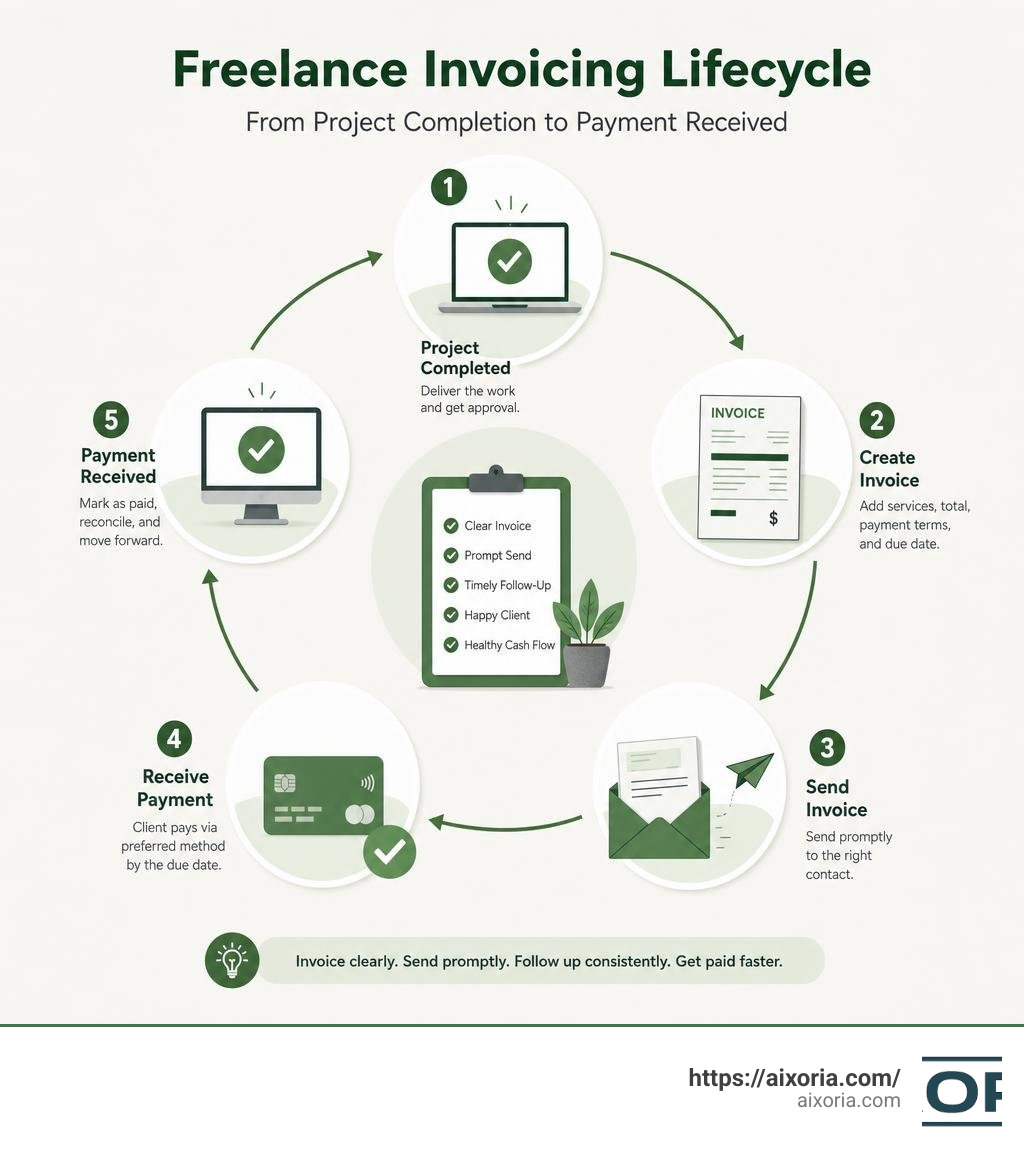
Step 1 & 2: Infrastructure and Essential Invoice Elements
Before you even write down a single line item, you need to decide on your infrastructure. As we look at the landscape in June 2026, freelancers have two main paths: manual templates or automated invoicing software.
When we are starting out, manual templates (using tools like Word, Google Docs, or Canva) seem like the easiest option. However, as our client list grows, the administrative overhead of manual tracking quickly becomes a burden. Let’s look at how these two approaches compare:
| Feature | Manual Templates (Word/Excel/PDF) | Invoicing Software (Automated Systems) |
|---|---|---|
| Setup Time | Fast (under 10 minutes) | Medium (requires initial account config) |
| Creation Time | 10–15 minutes per invoice | Under 1 minute per invoice |
| Error Risk | High (manual math, copy-paste errors) | Very Low (automated calculations) |
| Payment Speed | Slower (often manual bank transfers) | Twice as fast (integrated payment links) |
| Tracking | Manual spreadsheets | Automated dashboard & reminders |
| Scalability | Hard to scale past 5 invoices/month | Effortless scaling |
If you are trying to decide which route is right for your business, we have compiled a breakdown of the 7 Best Invoicing Software for Sole Traders in 2026 to help you evaluate your options.
What is the best way to invoice as a freelancer: Manual Templates or Software?
If you only send one or two invoices a month, manual templates are completely fine. You can easily write a professional invoice by stripping out client-specific details from a master document and exporting it as a secure PDF. To understand the baseline requirements of a professional layout, you can check out this comprehensive guide on How to Write a Professional Invoice in 2026: Ultimate Guide.
However, if you are sending more than five invoices a month, manual invoicing is costing you money. Think about the math: if you spend 15 minutes formatting, calculating, and emailing each of your 15 monthly invoices, that is nearly 4 hours of administrative work. At a freelance rate of $100/hour, that is $400 of non-billable time! In contrast, automated software reduces that time to under an hour per month, making it the more cost-effective option. For more details on choosing the right tools, see our breakdown of What is the Best Invoicing Software for Small Business.
Designing a Compliant and Branded Invoice Layout
Your invoice is more than just a bill — it is a extension of your professional brand. A messy, poorly formatted invoice implies messy work, whereas a clean, structured document tells the client that you run a professional business.

To ensure your invoice is both visually professional and legally valid, we must include twelve essential elements:
- The Word “Invoice”: Clearly displayed at the top of the page.
- Your Business Branding: Your professional name, logo, and consistent brand colors.
- Your Contact Information: Full legal name, email, phone number, and physical address.
- Client’s Contact Information: Legal company name, billing contact, and billing address.
- Unique Invoice Number: A sequential number for tracking.
- Invoice Date: The exact date the document is sent.
- Payment Due Date: A specific calendar date (e.g., “July 12, 2026”) rather than a vague term.
- Purchase Order (PO) Number: If required by your corporate client’s finance department.
- Itemized Line Items: A clear breakdown of services, quantities, rates, and totals.
- Subtotal, Taxes, and Balance Due: Accurate mathematical calculations showing any applicable taxes.
- Accepted Payment Methods: Explicit instructions on how to pay (e.g., bank transfer details, online payment links).
- Payment Terms and Late Fee Policies: The agreed-upon payment window and any penalties for late payments.
When it comes to invoice numbering, never start with “Invoice #1”. It signals to your client that they are your very first project. Instead, use a sequential tracking system starting with a year prefix, such as 2026-001 or INV-101. This keeps your records organized and prevents red flags during tax audits. For an in-depth look at how to structure these details, we recommend reading this guide on How to Create a Professional Freelance Invoice That Gets You Paid Fast · 1099Freelance.
Step 3 & 4: Payment Terms, International Billing, and Tax Compliance
Once you have your template or software set up, you need to establish how and when you expect to be paid. Managing cash flow is one of the biggest challenges we face as independent professionals. To protect ourselves, we should use structured billing models:
- Upfront Deposits: Always request a 25% to 50% deposit for new clients, projects lasting longer than a week, or any contract worth more than $500. This secures the client’s commitment and covers your initial time.
- Milestone Billing: For large projects, tie payments to specific deliverables (e.g., 30% kickoff, 40% first draft, 30% final delivery) rather than arbitrary calendar deadlines.
- Retainer Agreements: For ongoing work, bill a flat monthly fee at the start of each month. This provides predictable recurring revenue.
What is the best way to invoice as a freelancer to avoid late payments?
If you want to get paid faster, stop using Net 30 payment terms. Net 30 (which gives the client 30 days to pay) is a corporate standard that benefits the client’s cash flow, not yours. In practice, a Net 30 invoice often turns into a Net 45 or Net 60 payment as it winds through accounting departments.
Instead, opt for Net 14 or Due on Receipt. Shorter payment terms create administrative urgency. To back this up, include a standard late fee clause in both your contract and on the invoice itself — typically 1.5% interest per month on overdue balances. Even if you choose not to enforce it, the presence of a late fee clause creates psychological urgency that pushes your invoice to the top of the client’s pile. For more practical tips on formatting your terms, check out the Freelance Invoice Guide: What Actually Works in 2026 | Vortenza.
Additionally, make it as easy as possible for the client to pay. If you only accept bank transfers, a busy client has to log into their portal, copy-paste your details, and authorize the transaction. If you include an online payment link (allowing credit card or ACH payments directly from the PDF), they can settle the bill in seconds. While credit card processors charge a 2.9% fee, the fact that online payments get settled twice as fast makes it well worth the minor cost.
Navigating Making Tax Digital (MTD) and Global Tax Rules in 2026
Tax compliance is another critical area where freelancers often run into trouble. Depending on your location and where your clients are based, different rules apply:
- Making Tax Digital (MTD) in the UK: As of April 2026, self-employed individuals in the UK earning over £50,000 per year are legally required to keep digital records of their income and expenses and submit quarterly tax updates to HMRC using compatible software.
- VAT Registration Threshold: The UK VAT registration threshold stands at £90,000 in 2026. If your taxable turnover crosses this mark, you must register and charge VAT on your invoices.
- US 1099-NEC Reporting: If you are a US-based freelancer and a client pays you $600 or more in a calendar year, they are required to send you a Form 1099-NEC. You must provide them with a W-9 form so they have your correct tax ID (either your SSN or an EIN).
- Record Retention: The IRS recommends keeping all business and invoicing records for at least 7 years to protect yourself in the event of an audit.
When dealing with international clients, always agree on the billing currency before starting the project to avoid exchange rate surprises. For international bank transfers, SEPA transfers are the fastest and cheapest option within Europe, while the SWIFT network handles global wires (though often with higher fees).
If you want to invoice international clients professionally without the hassle of registering a company or setting up complex tax structures, you can use a platform that acts as a Merchant of Record. To learn how this works, read the Freelancer Invoicing Without a Company Guide 2026 – Remotify.
Step 5: Follow-Up Cadence and Dispute Resolution
Even with a perfect invoice, some clients will pay late. This is rarely out of malice — more often, your invoice simply got buried in an inbox or forgotten in a weekly accounting batch. To handle this, we need a systematic, professional follow-up routine.

Here is a highly effective follow-up cadence that preserves the client relationship while ensuring you get paid:
- Day 1 Overdue: Send a short, friendly, and direct email. Keep it strictly factual, attach the invoice PDF again, and include the payment link.
- Day 7 Overdue: Send a slightly firmer reminder. Ask if they need any additional information to process the payment.
- Day 14 Overdue: Pick up the phone. A quick, polite conversation with your primary contact or their accounts payable department resolves most administrative bottlenecks.
- Day 30 Overdue: Send a formal demand letter via email and registered physical mail. At this point, pause all active work on their account. Nothing motivates a client to pay faster than having their project put on hold.
- Day 45–60 Overdue: If the invoice remains unpaid, you may need to escalate the matter to a small claims court or a professional collection agency (which typically takes a 25% to 50% cut of the recovered amount).
Handling Invoice Disputes Professionally
If a client disputes an invoice, the golden rule is to stay calm and neutral. Do not take it personally. Refer directly to your signed agreement or contract, and provide clear supporting documentation, such as approved project briefs or itemized hourly time reports.
If the dispute is over scope creep (work that fell outside the original agreement), walk them through the extra revisions they requested and offer a reasonable compromise if necessary. However, stand firm on the agreed-upon rates for completed work. For a deeper dive into setting up contracts and templates that prevent these disputes, consult How to Invoice as a Freelancer: 2026 Guide With Templates | Briskly.
What is the best way to invoice as a freelancer?
The best way to invoice as a freelancer is to automate the entire process. While manual templates are a great starting point for beginners, migrating to a dedicated platform allows you to optimize your financial tracking and focus your energy on billable client work.
By utilizing professional platforms, we can streamline our business operations and ensure we never miss a payment. For a complete market overview, read our guide on the 7 Best Automated Invoicing Software in 2026 Complete Guide for Businesses.
Streamlining Your Workflow with Automation
When you transition to automated invoicing software, you unlock powerful features that templates simply cannot replicate:
- Recurring Billing: Automatically generate and send invoices to monthly retainer clients without lifting a finger.
- Automated Payment Reminders: Let the software send polite, scheduled follow-up emails to late-paying clients on your behalf. This removes the emotional awkwardness of chasing money.
- Client Portals: Give your clients a secure, centralized dashboard where they can view their active invoices, payment history, and payment methods.
- Accounting Integration: Seamlessly sync your sent invoices and received payments with your bookkeeping software, making tax season completely stress-free.
Beyond invoicing, integrating smart digital systems is a great way to reclaim your time. If you want to scale your freelance business, check out our reviews of the Best AI Productivity Tools for Entrepreneurs 2026 and explore our curated list of the Best AI Tools for Business Productivity.
Frequently Asked Questions about Freelance Invoicing
Do I need a registered company to invoice clients?
No, you do not need a registered company (like an LLC or Ltd) to invoice clients. You can legally invoice as a sole proprietor under your own legal name. In this setup, you will use your personal tax identification number (such as a Social Security Number in the US or a National Insurance Number in the UK) for tax purposes. If you work with corporate clients who require invoices from a registered business entity, you can use a Merchant of Record platform to handle the transaction compliantly.
Should I charge late fees on overdue invoices?
Yes. Including a late fee policy (typically 1.5% interest per month) on your original contract and invoices is highly recommended. While you may choose to waive the fee for a trusted client who pays a few days late due to an administrative hiccup, having the clause on your invoice creates psychological urgency and protects your legal right to charge interest on severely overdue balances.
How long should I keep copies of my freelance invoices?
You should keep copies of all sent invoices and payment confirmations for at least 7 years (in the US and Canada) or 6 years (in the UK and Europe). This ensures you are fully protected in the event of a tax audit. The easiest way to manage this is to store your invoices digitally in securely organized cloud folders, categorized by client and year. For more insights on the transition from simple templates to automated systems, see the guide on Freelancer Invoice: What to Include. Software Beats Templates. | Frihet Journal.
Conclusion
Getting paid for your hard work shouldn’t be a stressful chore. By setting up a professional, branded invoice layout, establishing clear payment terms, and automating your follow-up routine, you can protect your cash flow and project the authority of an experienced business owner.
At Aixoria, we are dedicated to helping independent professionals and entrepreneurs build highly efficient, productive businesses. If you want to leverage cutting-edge technology to automate your administrative tasks and optimize your daily workflows, Explore Aixoria AI Tutorials today!